
He is, perhaps, even more synonymous with Barcelona than Lionel Messi. A century after his death, Antoni Gaudí remains the city’s greatest draw. Eugene Costello follows in the footsteps of the man they called God’s architect...
Perhaps Barcelona’s most famous son isn’t Lionel Messi after all.
The footballer may have filled Camp Nou with wonder for nearly two decades, but it is another genius who continues to lure millions of pilgrims to the Catalan capital every year. More than a century after his death, Antoni Gaudí still defines the city’s skyline, its identity and, in many ways, its soul.
My daughter Evie and I had come to Barcelona for a long weekend, determined to spend it in Gaudí’s company. We had maps, guidebooks and carefully planned itineraries. All of that became secondary the moment we walked into our Skyline Suite at Hotel Arts.
Neither of us spoke.
Hotels are prone to hyperbole. Every view is “spectacular”; every room “luxurious”. This was one of the rare occasions when reality comfortably exceeded the marketing.
Views to die for
Beyond the marina, the Mediterranean shimmered beneath a cloudless sky. To our left stood the Torre Glòries—still affectionately called the Torre Agbar by many Barcelonins—which would later illuminate the night in an ever-changing kaleidoscope of colour. But the eye was drawn, again and again, to the pale towers rising in the distance.
The Sagrada Família dominates Barcelona in the way mountains dominate landscapes. It isn’t simply another building; it becomes the point by which you orientate yourself.
As dusk settled over the city, the view became almost theatrical. The last rays of the Catalan sun caught the white cross crowning the newly completed Tower of Jesus Christ before it began to glow against the deepening blue of the evening sky.
We had intended to head out for dinner.
Instead, we opened a bottle of cava and simply watched.
It struck me that there are plenty of ways to see Gaudí’s masterpiece. You can join the queues outside, admire it from the streets below or photograph it from countless viewpoints. But watching it from the Skyline Suites at Hotel Arts feels different. Elevated above the city, with the Mediterranean on one side and Barcelona unfolding beneath you, the basilica becomes part of a much larger story. It is an indulgence, certainly, but one that earns its price tag. Some hotel rooms are somewhere to sleep. This one is an experience in its own right.
A distinguished second place
There is another pleasing irony.
For years, Hotel Arts was one of Barcelona’s tallest landmarks. Then, after nearly 150 years of construction, the completion of the 172.5-metre Tower of Jesus Christ restored the Sagrada Família to the top of the skyline, complete with its illuminated cross. Although work continues on the monumental Glory Façade, Gaudí’s masterpiece has finally reached the height he always intended. Somehow it feels entirely appropriate that Barcelona’s tallest structure should be a church rather than an office block or luxury hotel.
Only a few weeks before our visit, Pope Leo XIV celebrated Mass inside the basilica during commemorations marking the centenary of Gaudí’s death. It was a reminder that despite welcoming millions of tourists every year, the Sagrada Família remains what Gaudí intended all along: a living church rather than simply Spain’s most extraordinary attraction.
Nothing, however, prepares you for walking inside.
Photographs tell you what it looks like. They cannot tell you how it feels.
The columns rise like giant trees before dissolving into a stone canopy overhead. Sunlight filters through stained glass in pools of sapphire, emerald, amber and crimson, moving across the white stone as the day unfolds. Every few minutes the entire building seems subtly transformed.
At one point I stopped trying to photograph it.
It seemed faintly ridiculous to reduce something so immense to a phone screen.
“No straight lines in nature”
Gaudí once observed that there are almost no straight lines in nature. Standing beneath those branching columns, you begin to understand what he meant. The building doesn’t appear to have been constructed so much as grown.
The Sagrada Família eventually became his entire existence.
He abandoned lucrative commissions, dressed increasingly simply and devoted almost every waking hour to the basilica. Towards the end of his life he even slept there, rising before dawn to supervise the work. Friends worried he was working himself into an early grave.
In a sense, he was.
In June 1926, walking to confession, Gaudí stepped into the path of a tram. His clothes were so shabby and his appearance so unremarkable that several passers-by assumed he was a beggar and paid him little attention. He died three days later without seeing even a quarter of the building completed.
The city eventually gave him the funeral of a national hero.
To understand why, you have to leave the basilica and follow his footsteps across Barcelona.
Gaudí’s other masterpieces
Casa Batlló is unlike anything else on earth.
Its balconies resemble masks—or perhaps skulls. The façade ripples like sunlight on water, while the tiled roof evokes the scales of the dragon slain by Catalonia’s patron saint, Sant Jordi. Every guidebook offers its own interpretation.
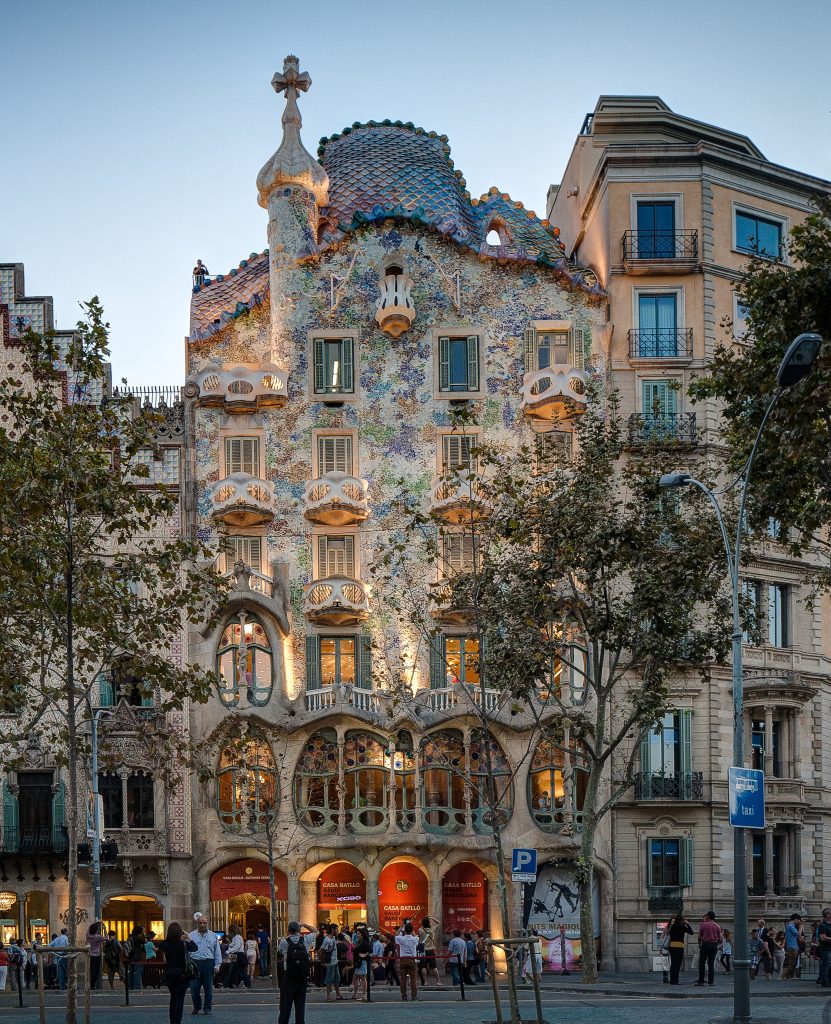
Evie required about three seconds.
“Dad,” she said, grinning. “It’s Floop’s castle.”
She was referring to the wildly eccentric castle from Spy Kids, and once she’d said it I couldn’t unsee it. Architectural historians may prefer dragons, bones and marine symbolism, but my daughter’s pop-culture comparison somehow captured the building’s playful absurdity perfectly. Gaudí, I suspect, would have enjoyed the observation.
A short stroll away, Casa Milà—better known as La Pedrera—feels like the work of the same imagination, only more mature. Waves of pale limestone sweep across the façade. Wrought-iron balconies twist like seaweed. On the rooftop, surreal chimney pots resemble an army of silent stone warriors gazing across Barcelona.
Standing there, I found myself wondering what Edwardian Barcelonins must have made of it. Today it feels visionary. In 1912 it must have seemed positively extraterrestrial.
Architecture becomes nature
The following morning brought Park Güell, where architecture appears to surrender entirely to nature. Columns lean because trees lean. Pathways follow the contours of the hillside rather than fighting them. The famous mosaic serpent, colourful benches and gingerbread gatehouses somehow avoid becoming whimsical because everything feels rooted in the landscape.
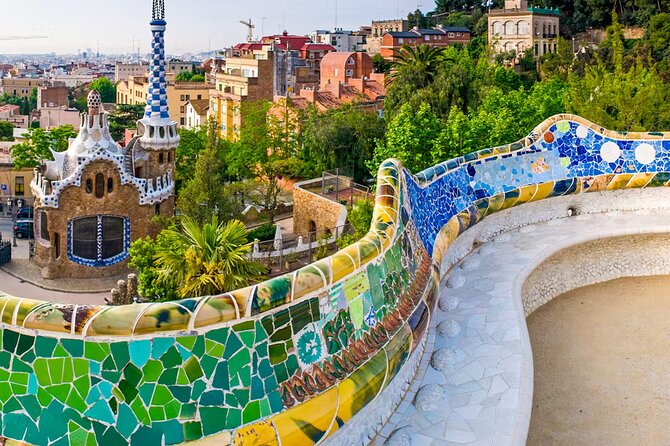
It is impossible to spend time there without smiling.
Children chase pigeons. Buskers play Spanish guitar beneath the columns. Every few minutes someone stops, points and laughs with delight.
Perhaps that is the simplest definition of great architecture. It reminds adults how to feel like children.
Not everyone was convinced.
Pablo Picasso reportedly regarded Gaudí with barely concealed contempt, dismissing the Sagrada Família as excessive and absurd. His fellow Catalan Salvador Dalí saw precisely the opposite. Dalí recognised a visionary whose dreamlike buildings anticipated Surrealism decades before anyone had coined the term. Where Picasso saw eccentricity, Dalí saw genius.
History has been kinder to Dalí’s judgement
More than a century after construction began, millions continue to make their own pilgrimage to Gaudí’s creations—not because they are perfect, but because they remain utterly unlike anything else ever built.
On our final evening we found ourselves back where the journey had begun.
The lights of the Torre Glòries pulsed across the skyline in shifting blues and reds. Beyond it, the illuminated cross atop the Sagrada Família seemed to hover above the city like a beacon.
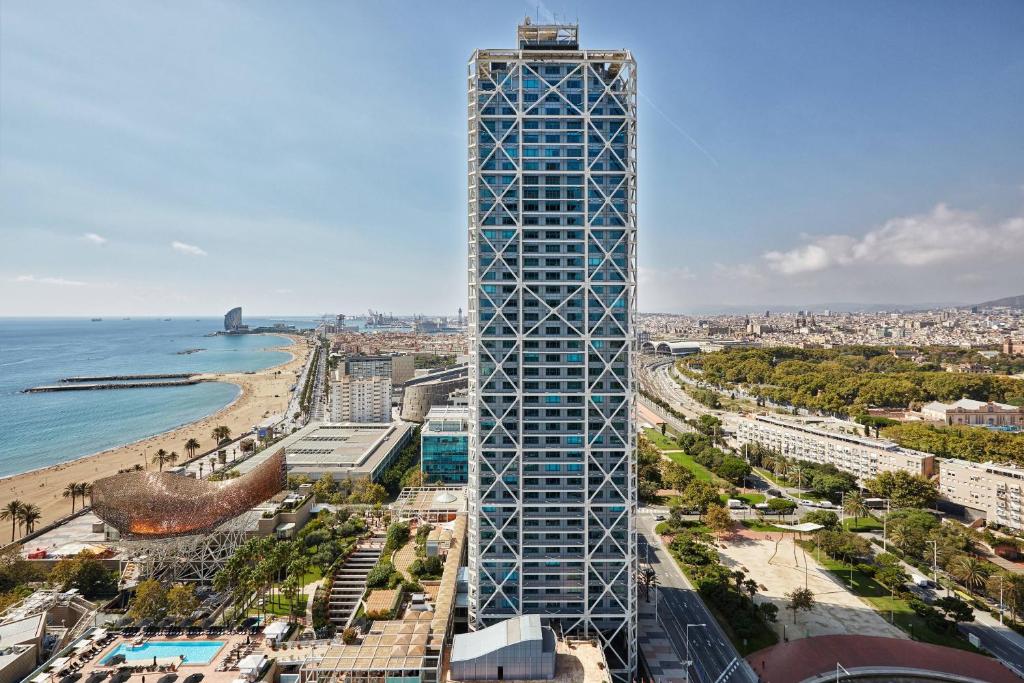
Neither of us felt much inclination to switch on the television.
Instead we sat by the glass, talking about the weekend, watching Barcelona sparkle beneath us.
Travel writers often search for a defining image of a destination. Barcelona offered us one without trying.
A century after his death, the city’s greatest hotel still looks up to its greatest architect.
And somehow, that feels exactly as Gaudí would have wanted it.
• Skyline suites at Hotel Arts, Barcelona, from 800€ per night; https://www.ritzcarlton.com/en/hotels/BCNRZ-hotel-arts-barcelona/overview/